
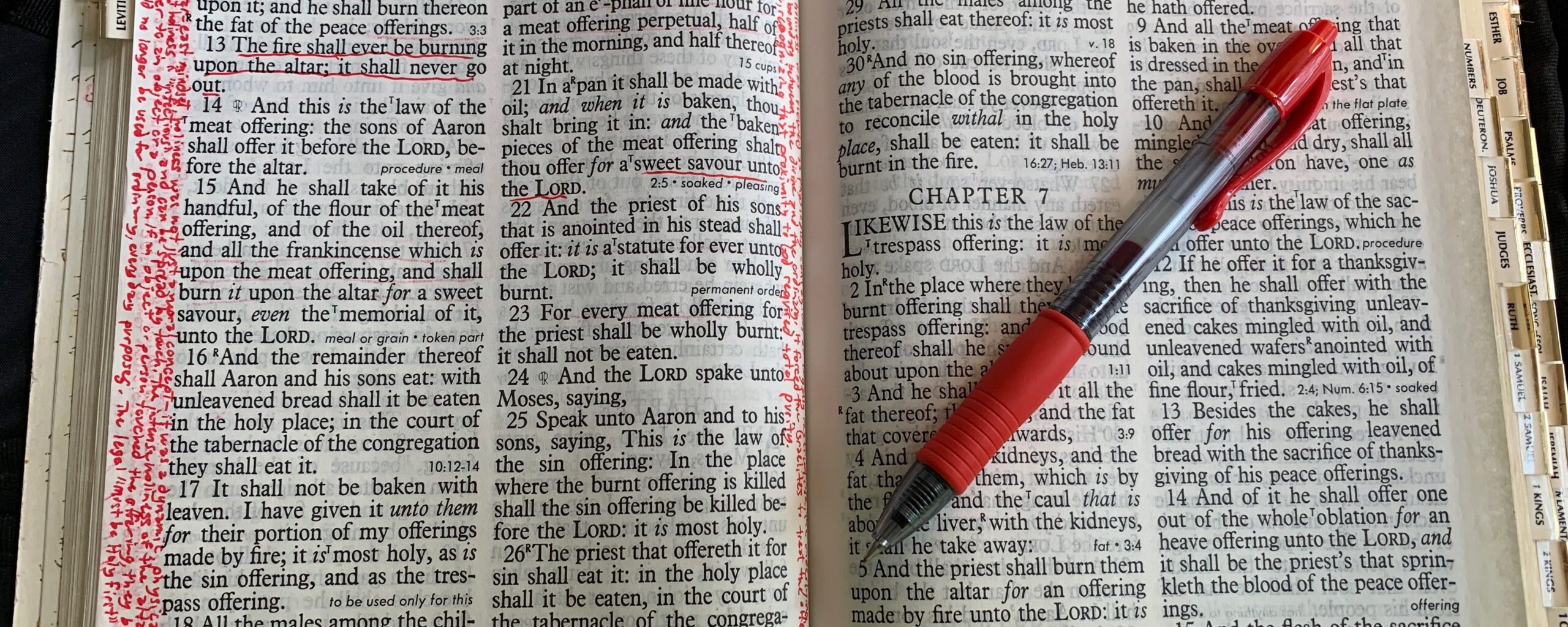
There is a profound connection between Leviticus 7:7 and John 6 that is grounded in the theological concept of the priest keeping and eating the sacrifice. In John 6:53-56, Jesus famously states: “Whoever eats my flesh and drinks my blood has eternal life… For my flesh is real food and my blood is real drink.”
To a first-century Jewish audience steeped in Levitical law, this statement was shocking. However, looking at it through the lens of Leviticus 7:7 reveals a powerful symbolic fulfillment.
1. The Priest’s Right to Eat the Offering
“The trespass offering is like the sin offering; there is one law for them both: the priest who makes atonement with it shall have it” Leviticus 7:7.
In Leviticus 7:7, God establishes a rule: the meat of the sin and guilt offering belongs to the priest who makes atonement. The priest takes the sacrifice, applies the blood, burns the fat, and then physically consumes the remaining meat as his sustenance. By eating the sacrifice, the priest structurally internalized the offering that brought forgiveness.
2. Jesus Inverts the Ritual in John 6
In the New Testament, Jesus is presented as both the Ultimate High Priest and the Perfect Sacrifice.
- In Leviticus: The priest eats the sacrificial animal to complete the ritual of atonement.
- In John 6: Jesus reverses this imagery. He is the sacrifice (the “Bread of Life” and the “guilt offering”), but instead of the Priest eating the sacrifice, the people are told to eat the Priest.
By “feeding” on Jesus through faith, believers internalize Jesus’ atoning death and receive eternal life rather than just temporary physical sustenance.
3. The Scandal of the Blood
Leviticus 7 strictly forbids anyone from eating or drinking blood, a sin punishable by exile. When Jesus tells the crowd in John 6 that they must drink His blood, he is intentionally provoking them to look past the literal animal sacrifices of the law. In the Old Covenant, animal blood could only cover sin temporarily; whereas in the New Covenant, consuming Christ’s life and sacrifice by faith cleanses a person entirely through Jesus’ once-for-all sacrifice.
What of all the Father gives me, Jesus promised He shall not lose even one?
At John 6:39, Jesus states: “And this is the will of him who sent me, that I shall lose none of all those he has given me, but raise them up at the last day.”
Tying this back into the Leviticus 7:7 sacrifice and eating imagery, this verse reveals the absolute certainty, permanence, and finality of the atonement Jesus provides.
4. The Ultimate Safety of the Sacrifice
In the Old Covenant Levitical sacrificial system, a sacrifice could be compromised through a blemished offering (Leviticus 22:20-22), an unclean priest making the offering, procedural violatons on the part of the priest in the offering or completion of the sacrifice (cf. Leviticus 7:18), or a corrupt heart on the part of the sinner or the priest. Moreover, the atonement was temporary and had to be repeated year after year.
Why This Contrast Matters for John 6
When Jesus speaks to the crowds in John 6, he contrasts Himself against all of these structural vulnerabilities:
- He is the perfect lamb without blemish (never compromised by a defect).
- He is the perfect High Priest (never defiled or unclean).
- His offer of His flesh needn’t be rushed to be consumed over two days for fear of it rotting, but as Eternal Bread that never spoils.
In John 6, Jesus presents Himself as the perfect, uncompromised sacrifice. Because He is a perfect offering given directly by the Father, His atoning work cannot fail. To “lose” even one person whom the Father gave Him would mean His sacrificial work was imperfect or insufficient. Jesus guarantees that His sacrifice is 100% effective.
5. Internalized and Permanently Kept
When you connect verse 39 to the later verses in John 6 (about eating His flesh and drinking His blood), a profound picture of security emerges
- If you merely look at a sacrifice from the outside, you can walk away from it and be separated from it.
- But when you spiritually consume the sacrifice by faith—internalizing Christ’s death and life—He becomes a part of you, and you become a part of Him.
Through faith believers are completely unified with the Sacrifice, and Jesus safely keeps them. Jesus will not allow what has been combined with Him to be torn away and lost.
6. Ultimate Preservation: The Resurrection
Jesus defines what it means to “not lose one” by adding: “…but raise them up at the last day” (John 6:39).
In ancient Israel, sin and guilt offerings could only clean a person ceremonially for this present life. They still died, and their bodies decayed. But Jesus’ sacrifice is so powerful that even death cannot cause a believer to be lost. The final proof that Jesus successfully kept everyone the Father gave Him is that He will physically resurrect their bodies to eternal life on the last day.
7. The Last Levitical Priest: John the Baptist and “Drawing Near”
Placing Levitical priesthood into its historical context, we see the entire Levitical priesthood and the book of Leviticus exist to answer one question: How can sinful humanity draw near to a holy God?
John opens his Gospel with priests and Levites investigating John the Baptist. John the Baptist was himself of Levitical descent (the son of the priest Zechariah). As a Levite, John’s role was to prepare and present the sacrifice. He fulfills this Old Testament tribal duty perfectly in John 1:29 when he points to Jesus and declares, “Behold, the Lamb of God!” The Levite prepares the way so that Jesus can do the final work of “drawing” humanity back to the Father.
In the Old Testament, the Hebrew word for a sacrificial offering brought by the Levites is Korban (קָרְבָּן), which comes from the root word karav, meaning “to draw near.” The Levites were the ministers who literally “drew” the offerings and the people close to God’s presence at the Tabernacle.
In the Gospel of John, Jesus fulfills and supersedes the Levitical priesthood. Instead of animal sacrifices drawing people near, Jesus declares in John 12:32: “And I, when I am lifted up from the earth, will draw all people to myself.” His crucifixion replaces the Levitical system by structurally pulling people from every nation directly into the presence of God.
Eric Landstrom