
To answer the classic Calvinist challenge—“Why one and not another?”—without falling into the trap of human merit or self-righteousness, I believe we must carefully examine the very premise of the question. The Calvinist assumes that if two people receive the same measure of grace, the one who accepts it must possess some superior intrinsic virtue or wisdom. However, drawing from my article, “Is Resistible Grace Effectual?”, published on the Society of Evangelical Arminians site, [1] I argue that the Wesleyan-Arminian response flips this question on its head: the difference is not the presence of a virtue in the one who accepts, but rather the active presence of a vice—the final rejection of God—in the one who perishes.
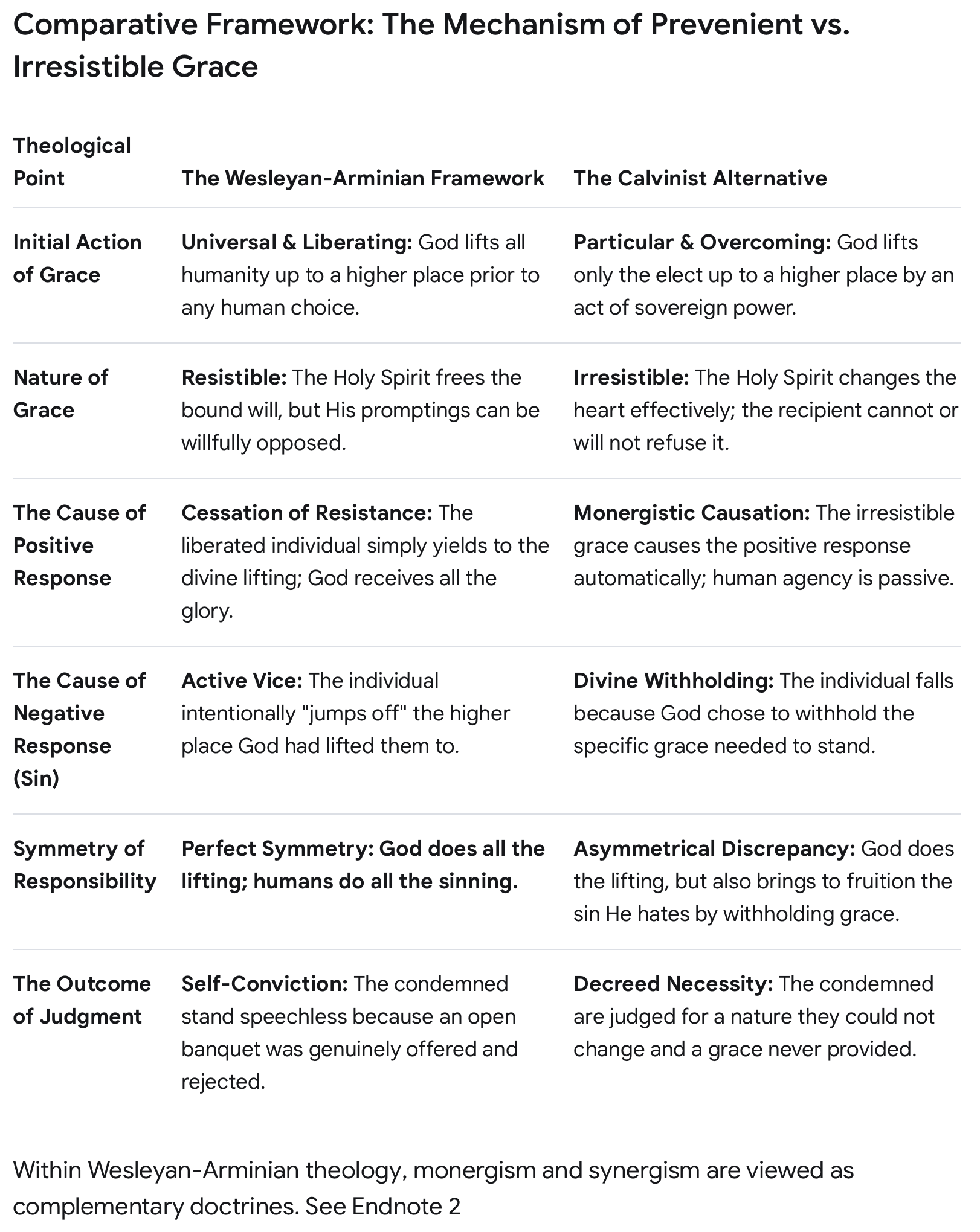
Consider, if you will, that the Arminian view can take the following form:
- God gives grace prior to any human response.
- As such, people are already lifted up higher by grace before they respond.
- As such, people don’t lift themselves up, God does.
- As such, when people respond negatively, they jump off of the higher place God had lifted them to.
- Hence, God does the lifting and people do the sinning. By introducing prevenient grace, this framework establishes that no one can boast about choosing God. God initiates everything, yet human accountability is preserved because a person must intentionally “jump off” the elevated platform of grace to perish.
Now consider the Calvinist alternative if grace isn’t resistible:
- God gives grace prior to any positive response and this grace is not resistible.
- As such, people are already lifted up higher by grace before they respond positively.
- As such, people don’t lift themselves up, God does.
- As such, when people sin, they sin because God withheld the grace they needed to resist temptation.
- Hence, God does the lifting and also brings to fruition the sin he hates. If grace cannot be resisted, then the presence of sin or unbelief must logically track back to God intentionally withholding the specific, effective grace needed to stop it.
The truth is that people are not Turing machines, and neither are they automatons. The human race was created in the image of our Maker and given a will. Fallen and apart from grace, the will is under bondage, darkened, and restricted to choices among many evils. Yet our Lord doesn’t leave humanity that way. He pours His Spirit out upon all flesh, and with His Spirit, our Lord pours out the grace which, if not rejected, liberates the will from sin’s dominion so that we can begin to move closer to God by choosing the good over the evil. Yet men love darkness because their deeds are evil.
Even so, the Father continues to call to all evil-doers and seeks to draw them near through His Son by the ministry of the Spirit, who works by means of grace to illuminate the intellect and strengthen the human will to do good. The ministry of God the Spirit works to draw all people to repentance by awakening their radical need for salvation and driving a thirst for life—a thirst that can only be met at the wellspring of eternal life, the life of Christ. The Spirit’s work of grace is precisely in the mind and heart, going before the fallen will can act, thereby freeing it to move. Thus, the Spirit gives grace to spur righteous responses. One person embodies and responds to the grace that God has given, while another does not. Come the judgment seat, every individual will be judged for what they have chosen, for it is written, “For we must all appear before the judgment seat of Christ; that every one may receive the things done in his body, according to that he hath done, whether it be good or bad” (2 Cor. 5:10).
From a pastoral perspective, grace, like the sun, shines upon all people. Some receive grace with joy and run toward God so as to receive more grace, while others flee from the grace they have received and try to further hide themselves from God. The difference between those who receive grace with joy and those who revile and shrink from it is the same as those who return love with more love and those who respond to love with hatred. And this is not strange; sons and daughters who love their fathers find comfort in their fathers’ arms, while the sons and daughters who hate their father find their father’s embrace an embarrassment and painful. The difference between the two is a choice between how grace is received.
Endnotes:
[1] Eric Landstrom, “Is Resistible Grace Effectual?,” Society of Evangelical Arminians, accessed October 27, 2026,
https://evangelicalarminians.org/eric-landstrom-is-resistible-grace-effectual/.
[2] It is helpful to note that within traditional Wesleyan-Arminian theology, monergism and synergism are not inherently viewed as competing doctrines, provided they are understood in their proper contextual frameworks. When confronting the questions “Who does the healing?” and “How are we healed?”, these concepts become complementary rather than contradictory. In terms of the Who, salvation is entirely monergistic: God alone is the sole source, author, and finisher of our salvation. Human beings contribute no independent power or merit to their rescue. However, in terms of the How, the process is synergistic: God’s grace operates dynamically to bring about faith and repentance within the individual. Ultimately, this tension is beautifully resolved through the Holy Spirit’s sequential ministry of grace, which works first in us, then through us, and finally—once our will is supernaturally freed—with us.