📱 The Growth of a Believer
Young Christians often seek unity because their shared faith experiences connect them to others (Ephesians 4:4–6). However, as spiritual maturity deepens, believers often feel the need to anchor their personal experiences within historic doctrines. Through this normal growth, a young Christian naturally develops into a confessional believer with distinct denominational interests.
📜 Foundations of Unity
The Bible teaches that believers share a unity found in God and rooted in seven fundamental scriptural truths:
One body & One Spirit
One hope & One Lord
One faith & One baptism
One God and Father
“Till we all come in the unity of the faith… unto a perfect man, unto the measure of the stature of the fullness of Christ.” — Ephesians 4:13
📣 The Command to Live Out Unity
Scripture treats unity as a matter of strict obedience, not optional goodwill. Believers must actively preserve what Christ has already made one:
The Pastoral Prayer: Jesus prays “that they all may be one” (John 17:11, 21–23). This is one of the church’s primary callings.
The Appeal Against Division: Paul urges that there be “no divisions among you,” but that you be united in the same mind and judgment (1 Corinthians 1:10).
The Call to Maintenance: Believers must be “eager to maintain the unity of the Spirit” (Ephesians 4:3). Unity exists; we must keep it.
The Mindset of Harmony: Paul asks the church to be “of the same mind, having the same love” (Philippians 2:2).
The Summary of Character: Peter commands unity of mind, sympathy, brotherly love, and humility (1 Peter 3:8).
Note: While unity is commanded, the Bible leaves the church to work out remaining doctrinal differences under the guidance of the Spirit and Scripture.
⚖️ The Ecumenical Dilemma
How do we resolve differences? Scripture provides clues rather than an exact blueprint. The noble Bereans sifted the Scriptures, and the first Jerusalem Council hashed out differences through open dialogue. Working out these differences under the Holy Spirit is a vital part of thinking with Christ—revealing His love through patience.
🔄 Two Historical Approaches
Historically, theologians have taken different paths to achieve this consensus: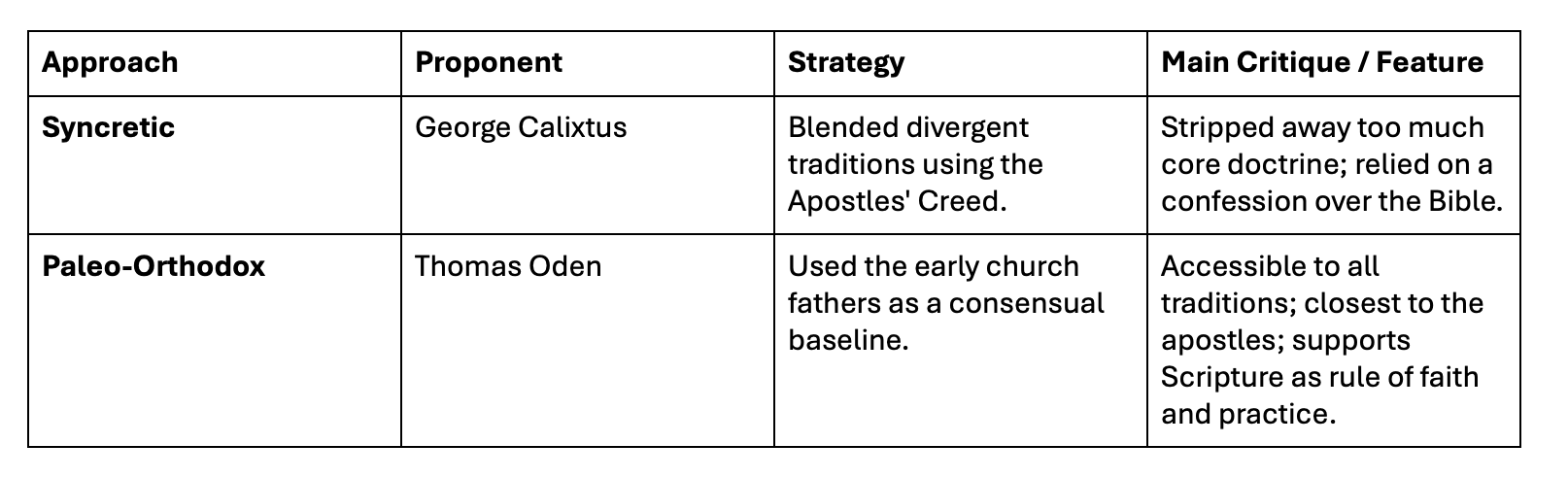
🛡️ The Rule of Faith (Regula Fidei)
First used by Irenaeus of Lyons (130–200 AD) against Gnostic elitism, the regula fidei establishes that Christian truth is public and ecclesial, not private. The earliest Church Fathers (ECFs) treated Scripture as the judge of teaching; later Protestants saw that as what would become the roots of the Protestant doctrine of sola Scriptura.
🔍 The Vincentian Rule
In his Commonitory, Vincent of Lerins offered a classic method to define orthodoxy: true Christian faith is what has been believed by everyone, everywhere, and at all times.
The Three Criteria
Universal Faith: Confessed by the church worldwide.
Apostolic Continuity: Formed by the historic witness of the apostles.
Conciliar Consent: Tested and confirmed by generations of cross-cultural reception across churches and ecumenical councils.
The Rule in Practice
Universal over Particular: Prefer worldwide historical consensus over isolated contemporary opinions.
Antiquity over Innovation: Appeal to ancient apostolic roots if a local or modern culture goes astray.
Precedent over Questioning: Look to established conciliar decisions and canons when apostolic testimony is questioned.
⏳ Four Filters for Evaluating Truth Claims
To sift through complex theological claims, apply these four criteria in strict order of priority:
1) The Whole over the Part: Universal truth outvotes local variations.
2) The Old over the New: Ancient apostolic witness outvotes modern consensus.
3) The Tested over the Untested: Evaluated conciliar decisions outvote untested faith claims.
4) Consensual Antiquity over the Minimal: Where no council has ruled, the most widely accepted ancient authorities prevail.
Context: Ancient ecumenical consensus is typically charted through the Eight Great Doctors of the Church: Athanasius, Basil, Gregory of Nazianzus, and John Chrysostom (East); Ambrose, Augustine, Jerome, and Gregory the Great (West).
🔬 Case Study: Historical Application to Arianism
When we apply the four filters to the ancient heresy of Arianism, we see exactly why it failed the test of orthodoxy:
The Lust for Novelty: Arianism marketed itself as a modern corrective to “outdated” views. Today, this mirrors a chronological chauvinism that assumes newer ideas are inherently superior to ancient truths.
Neglect of Balanced Consensus: Arius isolated specific verses rather than comparing Scripture with Scripture under the guidance of the Spirit.
Default of the Teaching Office: The movement prioritized the opinions of contemporary teachers over the long history of apostolic interpretation.
Violation of Established Tradition: Stable apostolic communities were disrupted by trendy theological novelties, temporarily trading scriptural truth for political power.
❓ Critical Questions & Answers
Did God establish the Vincentian Rule?
No. It is simply a helpful, human method to identify what is orthodox across Christian traditions. However, it relies on the scriptural premise that the Holy Spirit providentially guides the Church. Any effort to reconcile divided believers requires an agreed-upon method, and the Vincentian Rule provides a framework.
Does being a Christian guarantee perfect doctrine?
No. True salvation requires saving faith in Christ and a proper understanding of the Godhead, but it does not make a believer instantly infallible. Scripture shows God’s servants holding wrong beliefs in both the Old Testament and the early Church (e.g., the debate leading to the Jerusalem Council in Acts).
Must a person submit to this rule to be a Christian?
No. The Vincentian Rule is a logical tool for finding consensus, not a ruling magisterium. The ultimate goal of orthodoxy is not forced uniformity on every minor issue. Rather, the goal is that all believers hold fast to that which cannot be disbelieved without losing the faith entirely.
📚 Current Impact & Notes
Efforts to recover this ancient consensus are producing significant contemporary resources for lay readers:
One Faith: The Evangelical Consensus (A major collaborative document).
The Ancient Christian Commentary on Scripture series.
New translations of Latin and Greek church father writings previously inaccessible to the public.
Thomas Oden’s vast library, including his systematic theology and pastoral works.*
Final Thought: Only time will tell if paleo-orthodoxy—now rebranding as “Ancient Christianity”—will successfully lead the modern global church back to a unified consensus on what cannot be denied.
Eric Landstrom
* For example, Thomas C. Oden did the Body of Christ an enormous service in his book, Rebirth of Orthodoxy: Signs of New Life in Christianity, by unpacking the Vincentian method. More about Oden’s theological method can be found in my paper, Eric Landstrom, “Thomas Oden’s Paleo-Orthodoxy,” available: https://evangelicalarminians.org/eric-landstrom-thomas-odens-paleo-orthodoxy/