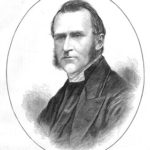
Will animals take part in the new creation promised in Revelation 21-22? Throughout most of Christian history the popular assumption has been they will not. The bible does not say they will (since they are not made in the divine image). A fascinating aspect of John Wesley’s eschatology is that he came to believe in animal redemption. To understand Wesley’s perspective we first need to look at his natural philosophy.
Great Chain of Being
A dominant idea in natural philosophy in Wesley’s day was a concept of cosmology that arranged everything in vertical order like a chain. It has been called the Great Chain of Being, and was derived from Greek philosophy. The basic idea is that everything which exists from God down to the minerals of the earth are linked together like a chain, with those beings on top having the most essence or pure being, and those lowest with the least amount of pure being. The basic structure can be outlined from left to right as follows:
God – Angels – Humanity – Animals – Minerals
The idea that all reality is linked together was also used to structure society (King & nobles on the top, slaves at the bottom). In this scheme perfect harmony and order required each link to remain in its position so the entire Chain can remain stable and connected, bringing blessing and happiness to the whole.
In the Great Chain the human race serves as the connection point between the spiritual and material realms. At creation, Adam ruled over the animals and earth (Gen. 1:26-28). As he was blessed, so were they. As he enjoyed life, so did they. So, when Adam sinned, the animal world also fell under the curse of death due to human sin. Therefore, it was reasoned that our redemption from the curse will also include the lower creation. This viewpoint looked to Apostle Paul’s brief remarks in Romans 8:19-22 that the entire creation is longing for deliverance from the curse.
Wesley learned about the Great Chain of Being while at Oxford, but in the 1770s he read several works that convinced him that animals have souls and will be redeemed along with the people of God in the new creation. He spelled out his views on animal redemption in the sermon The General Deliverance.
The General Deliverance
This sermon has three parts. The text is Romans 8:19-22 (KJV). Here is the link: Sermon General Deliverance
The first section extrapolates from Adam’s perfection in the beginning to draw conclusions about the perfection that animals enjoyed in the Garden of Eden. Just as Adam was perfect in all ways and blessed by God, so animals were perfect according to their compacity and were blessed by God – through Adam’s federal headship. There was perfect harmony in the animal kingdom with no animals being devoured by other animals.
In the second section Wesley describes the impact of the Fall on the animal kingdom. The animals were now made “subject to vanity,” so that their understanding became more clouded and they experienced a loss of vigor and swiftness. Animal passions became distorted and began to eat and devour each other. Wesley goes into detail about the savagery by which animals attack and devour each other. Wesley concludes that by Adam’s one sin, death not only passed to every human being, but also to the animal kingdom.
Part Three offers hope to the animal kingdom that they too will be granted deliverance from the corruption that enslaves all living things in the present age. Just as the future state for humanity will be much higher than what Adam enjoyed at the beginning, so the animal kingdom will be lifted to a higher plane than was experienced in the Garden of Eden. Their level of intelligence will probably match what we as humans enjoy right now (and ours will be higher like the angels). Their compacity for God will therefore increase dramatically, compared to their present state.
In the resurrected state, the entire Chain of Being will give glory to the Creator who has loved and redeemed them.
For more information, read the article on Wesley’s eschatology: From Heaven Above to New Creation Below
[This post was taken with permission from the Featured Monthly Resources Page on Mark K. Olson’s website.]