
Along with them, we all once lived by the passions of our flesh, doing the desires of the body and of the mind. Like the rest of them, we were children of wrath. What do…
Scripture Index
Ephesians 2:1-2; A Devotional
And you were dead because of the transgressions and sins in which you once walked, as the world has through the ages according to the ruler of domain of the air ; the spirit now working in the unyielding6 sons.
A major aspect of Christian life is remembering where you came from. Christianity is fundamentally a faith of redemption. Part of redemption is being redeemed from something.
There are two common problems we encounter when dealing with our sinful past.
Ephesians 1:22-23; A Devotional
And He set everything under His feet, and made Him head over the assembly which is His body: the very thing which fills every bit of everything.
Ok, let us recall Paul’s context:
Which Comes First, Faith or Regeneration?
Although I argued that “what” regeneration is is more important than “when” regeneration happens, we do still need to touch on the question of the timing of regeneration. These passages show that regeneration comes after…
Ephesians 1:19b-21; A Devotional
…according to the work of His mighty strength which was worked in Christ, arousing Him from the dead and sitting Him at God’s right side in the celestial realms, far above any ruler, authority, power,…
The Apostle John’s World
Recently, I have found myself focusing on the effects of a word or two, sovereignty and dominion being the last foray. Today the word world comes into play. It is a long disputed term, used…
Ephesians 1:18-19; A Devotional
“…having your mind’s eye enlightened in order to perceive what is the hope of His invitation, what is the glorious wealth of His inheritance in the saints and what is the surpassing greatness of His…
Friday Files: Hamilton – The Order of Faith and Election in John’s Gospel
Robert Hamilton makes a very good case that passages such as John 10:26 ‘you do not believe, because you are not my sheep’ refers primarily to the faithful sons of Abraham who were God’s children…
Ephesians 1:17; A Devotional
…that the God of our Lord, Jesus Christ, the Glorious Father, may give you the spirit of wisdom and of revelation on the knowledge of Him… This verse is a verse about the Father, and,…
Friday Files: Benson on John 6
Benson’s comments on the ‘giving’ and ‘drawing’ in John 6 (Volume 4 pages 563-565) are reasonably simple. First, Benson notes the passage teaches man’s depravity; no man can believe in Christ to the saving of…
Ephesians 1:15-16; A Devotional
Because of this, and because I heard about your faith in Lord Jesus and about your love toward all the saints, I’ve not stopped praying for you, recalling you to mind in my prayers. The…
Friday Files: Benson on Acts 13:48
Joseph Benson makes several key points in his commentaries on Acts 13:48 page 772. He argues that the Calvinist translation of tasso entails reprobation and impugns the God’s character. He argues that the Calvinist view…
Ephesians 1:13-14; A Devotional
In whom you also have heard the word of truth: the gospel of your salvation by which, having believed, you were sealed by the promised Holy Spirit who is the down payment of our allotment,…
Friday Files: Whitby on Acts 13:48
Dr. Whitby discusses Acts 13:48 in his Discorses on the 5 Points, page 70. First, he gives three problems with the Calvinist translation and then provides multiple examples of how tasso ‘ordained’ is often translated…
Ephesians 1:11-12; A Devotional
Furthermore, in Him we have been chosen by lot (being predetermined according to the plan by which all things are worked out and according to the purpose of His will) to be who we are,…
Ephesians 1:7-10; A Devotional
Because this is all one sentence in the Greek, I wanted to go back and treat it the way it deserves: as one thought.
[It is in the Beloved that] we have redemption through His blood: the excusing of sins according to the abundance of His grace which He teemed into us in all wisdom and understanding having revealed to us the secret of His will, according to His good judgment, which, through Christ, was preplanned for managing the fulfillment of times in order to coalesce all things in Christ throughout the heavens and the earth.
Friday Files: On Morison’s Commentary on Romans 9
In James Morison’s commentary on Romans 9, he makes the three helpful points about God’s promise that the greater shall serve the lesser. First, it was not said of Rebecca but to her, second it…
Exegeting 1 Timothy 2:4: God Our Savior, Who Desires All People To Be Saved
To some Calvinists, the very mention of an Arminian exegesis of 1 Timothy 2:4, in an effort to defend the biblical notion that God desires the salvation of every individual on earth, is insulting, both logically and theologically.
As Alan Kurschner, from the Triablogue blog, stated, “Arminians start with the human-centered assumption that if God does not love all people undifferentiated, then he would be unjust to love some more than others. The Calvinist begins with the Biblical principle that because man is unworthy of grace and deserving only of death, God in his holiness, wisdom, and freedom chooses to love and elect any creature he desires.”
Ephesians 1:9-10; A Devotional
As I said last time, 7-10 is one sentence, so it is important to have 7-8 in mind as we read 9-10. I intend to recapitulate this section next week, but for now, we’ll just…
Brennon Hartshorn, “Proof-texting without Context: A closer Look at 2 Timothy 2:25”
Some well-meaning Christians make the mistake of using proof texts to prove a theological point without considering the context of the larger passage that the proof text comes from. It is important to keep in…
Recent Posts

Roy Ingle, “When Does Debating Theology Become Wrong?”
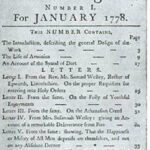
The Arminian Magazine 44 Issue 2 (Fall 2026)

How Did the Son of God Become Human? (Global Methodist Church Catechism)

Eric Landstrom, “Provisionism: Forgetting What Shouldn’t Be Forgotten, Part II: A Defense of Inward Grace”