Please click on the link to listen to the interview. Here is the Reformed Forum’s description of the interview from the interview’s web page, which also has a bibliography of Dr. Stanglin’s works: Dr. Keith…


Please click on the link to listen to the interview. Here is the Reformed Forum’s description of the interview from the interview’s web page, which also has a bibliography of Dr. Stanglin’s works: Dr. Keith…
One of the most frustrating aspects for the followers1 of Jacob Arminius’ teachings on God’s nature, character, salvation — including grace, election unto salvation, justification and conditional perseverance with an accompanying final or ultimate salvation…

BEN: As we conclude this discussion, let’s talk about the practical implications of Arminius’ thought for today. It seems clear to me that Arminius, and Wesley as well, would have rejected recent ideas that have…
BEN: What Arminius has to say about final justification seems to exclude the idea that works of piety and charity have anything to do with it (rather he opts for simple persevering in the faith…
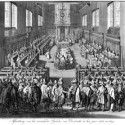
This lecture was given on March 31, 2016 at the Junius Institute for Digital Reformation Research’s Colloquium entitled, “The Leiden Synopsis Purioris Theologiae (1625) and Theological Disputation in the Era of Orthodoxy” held at Puritan Reformed Theological Seminary…
BEN: Arminius seems to be clear on the possibility of both intellectual and moral apostasy by a believer. Can you unpack his views for us briefly? Does he take the malicious rejection of Christ or…
KEITH: Arminius did agree that the righteousness resulting from this reckoning comes to believers on the basis of Christ’s righteous obedience to the Father. Thus, in a sense, it is Christ’s righteousness that is imputed…
BEN: One of the things that is not clear to me from reading your book is the relationship between the Holy Spirit and prevenient grace in the thought of Arminius. Does by grace Arminius simply…

A Theological Dirty Word Recently I’ve noticed that, over the past century, Arminians have increasingly used the word “synergist” to describe themselves, rather than seeing it as a negative epithet, as most Christian theologians have.…
BEN: Why was Arminius accused of Pelagianism or semi-Pelagianism if in fact he was clear that prevenient grace comes to a person purely by unmerited divine initiative? KEITH: This controversy is inherent in the Protestant…
BEN: In regard to the old chestnut about God’s knowing and willing it seems clear that Calvin would say God knows it because he wills it, and therefore Calvin makes God’s will (and its exercise…

BEN: Would it be correct to say that Arminius rejects Calvin’s strong distinction between the secret decrees and will of God and the revealed will of God, which allowed for the possibility that God’s revealed…
BEN: Arminius seems to work hard to avoid making God the author of sin, or of anything evil for that matter, including the Fall. He is very willing to talk about God’s ‘permissive’ will when…

Too many Arminians have pushed their tray through the theological cafeteria, accepting a helping of whatever sounded good. Before we accept all the popular theology of the celebrity teachers, we had better determine upon what…
BEN: There is also a strong emphasis early on in the book on what is called the ‘intellectualist’ approach to the nature of God, which is to say that God’s knowledge is given priority over…
Arminianism, as with the overall theology of the early Church fathers, will never die. Calvinism experiences ebb and flow in popularity but Arminianism and other non-Calvinistic theological systems remain constant. I argue, though, that Calvinists…
BEN: Jacob Arminius seems to be a frequently misrepresented theologian, whose works have been neglected, and lack readily accessible translations into English from the Latin and Dutch. To what would you attribute this neglect, and…
Of late there has been an attempt, rightly in my view, to clear away a lot of misconceptions and in fact misrepresentations of Arminian theology, including the misrepresentation of Arminius himself as either a Pelagian…

Someone asked whether one should refer to classical Arminianism as Reformed Arminianism (some prefer Reformation Arminianism). Arminian Baptist James Leonard commented to me personally that his hope is that people will not think that we…

There is a flurry of activity at present from quarters in the Arminian theological community on the doctrine of corporate election. The exponents of this view are able and must be reckoned with, both by…