Please click on the link to view: John Shaw Banks, A Manual of Christian Doctrine (1902).
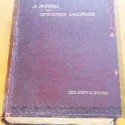
Please click on the link to view: John Shaw Banks, A Manual of Christian Doctrine (1902).
This 1658 work is a lengthy rejoinder to multiple Calvinist rebuttals written against Goodwin’s Arminian magnum opus, Redemption Redeemed (1651). It includes response to John Owen’s critique. The book runs 515 pages. It has a…
Recently, we posted an analysis by one of our members (Robert) of a portion of Justin Taylor’s interview of Calvinist scholar, John Feinberg, about his book Ethics for a Brave New World. In that analysis,…
This article defends the concept of corporate election against the criticisms that have been leveled against it, showing that they arise mostly from misunderstanding of the concept. It argues that corporate election is the biblical…
We are happy to announce the publication of Arminius Speaks: Essential Writings on Predestination, Free Will, and the Nature of God, edited by SEA member John D. Wagner and dedicated to SEA.
Here is a book description and some endorsements (for an attractive flier with a picture of the book on it and information on the publisher, see the attachment to this post; the book can be purchased at a discount through the publisher’s website [less expensive than listed on the flier]):
James Arminius is one of the most maligned and misunderstood theologians in
church history. In an era of major debate over predestination, free will, and
related concepts, Arminius was accused of being Pelagian, Semi-Pelagian, or a
heretic of all sorts. This is a trend that started in his time and has continued
to this day.
The truth is that he was a brilliant theologian who shook the foundations of
Calvinism to the core. Yet he was quite orthodox in his thinking, as he had
Southwest Alabama Bible Conference 2011 “Reclaiming Grace … A Biblical Response to Five Point Calvinism” “For by grace you have been saved…” (Eph. 2:8) At Grove Hill Baptist Church January 30 – February 2 See…
In light of the year’s ending, here are some lists of top news items from 2010 that might be of interest to those of us who are interested in theology: Christianity Today’s Top 10 News…
Please click on the attachment to view Robert Hamilton’s “Election in Romans Chapter Nine”: Hamilton. Election in Romans Chapter Nine
Laurence Womock, The Calvinists Cabinet Unlock’d is a major anti-Calvinistic work written by Laurence Womock, a 17th century English Puritan Arminian bishop and theologian, published in 1659. Book length is 634 pages. The full title…
Please click on the link to view Paul Copan, “Divine Exasperation”, which surveys biblical passages that express God’s exasperation with sinful, human resistance to his grace, revealing “God’s legitimate expectation of spiritual fruitfulness, repentance, or obedience.…
The following post can be found on Rachel Held Evans’ site. It has been authored by her, and makes for a good follow-up to Roger Olson’s recent post here, What The Calvinism I Oppose Is…
Please click on the attachment to view Brian P. Irwin, “Yahweh’s Suspension of Free Will in the Old Testament: Divine Immorality or Sign-Act?” Tyndale Bulletin 54.2 (2003) 55-62.
The author’s summary:
Several passages in the Old Testament portray Yahweh as behaving in
ways that seem unfair or immoral. Two such narratives are the
episodes describing the hardening of Pharaoh’s heart and the spirit
dispatched to deceive Ahab. In each of these two cases, careful
attention to the literary context and the final form of the MT shows that
Yahweh’s behaviour is best understood as a sign-act directed toward a
specific end.
Taken from http://www.catalystresources.org/issues/351Walls.htm
WHAT IS WRONG WITH CALVINISM?
One of the most longstanding debates in the history of theology concerns the relationship between predestination and human freedom. On one side of this dispute, the most famous name is John Calvin, and on the other the most noted name is probably John Wesley. Although Wesley was primarily concerned with evangelism and church renewal, the very nature of his work required him to take positions on certain controversial issues. Perhaps the most significant of these involved his disputes with Calvinism; indeed, his work on these issues represents one of his most important contributions to historical theology.
Taken from http://arminiantoday.blogspot.com/2010/06/jack-cottrell-on-free-will.html
QUESTION: Many (usually Arminians) argue that without free will in a significant (libertarian) sense, i.e., the ability to choose between good and evil, human actions would not be worthy of praise or blame. Thus in order to preserve moral responsibility, human beings must have free will in the libertarian sense—the freedom of opposite moral choice. But is this consistent with the freedom of God Himself, whom we assume to be the ultimate model for freedom? The following are said to be true of God:
1. God is surely the freest being in the universe. He is free to do whatever he pleases (Psalm 115:3), and all his choices are surely praiseworthy.
The sovereign God “decides who will believe and undeservingly be saved and who will rebel and deservingly perish.” —John Piper, “How God Makes Known the Riches of His Glory to the Vessels of Mercy,” sermon…
We would do well to apply the message of the cartoon in the attachment to the Arminian/Calvinist debate (see the attachment). The debate is very important, ultimately having to do with the character of God.…
We just added volumes 1 and 2 of Daniel Whedon’s commentary on the New Testament to the site, and so now have all 5 volumes . A link to each volume can be found on…
We recently ran a blog post entitled “Some Chilling Quotes of John Calvin” (http://evangelicalarminians.org/SEA.march-2010.some-chilling-quotes-of-John-Calvin) that used two of three quotes improperly, and we apologize for the error. Someone alerted us to a response he put together (www.corkfpc.com/chill.html) demonstrating that, out of context, one of the quotes gave the wrong impression of Calvin’s meaning, and that another quote was actually Calvin quoting an opponent’s characterization of Calvin’s view for the purpose of denying that to be his view. However, the SEA member who provided the quotes to us has written a response explaining that he did not intend to quote improperly and detailing why the quotes remain chilling in light of Calvin’s theology and other things he said: http://examiningcalvinism.blogspot.com/2010/03/clarification-on-chilling-quotes.html. There was no problem with use of the third quote from that post; it remains chilling without qualification.
“The Remonstrants clearly were not Pelagians.” You would think that such a statement comes from the lips or pen of an Arminian scholar or pastor, but it originally came from Reformed Baptist scholar Mark A.…